


When someone searches “plumber near me” or “best dentist in Austin,” they rarely scroll. They look at the map, read a few reviews, and call. Increasingly, they also ask ChatGPT, Gemini or Google’s AI Mode the same question and get a short list of names.
If a business isn’t in that map pack or that short list, it practically doesn’t exist for the buyer.
The good news is that local SEO is one of the most predictable parts of search. The businesses that win usually do the basics better and more consistently than their competitors. This checklist covers what matters in 2026.
Quick answer: how do you rank in Google’s local results?
To rank in Google’s local results, complete and verify your Google Business Profile with the right primary category, keep your name, address and phone identical everywhere, earn a steady flow of genuine reviews and reply to them, build a dedicated page for each service and location, and add local proof such as real photos, prices and projects. Google says local results are based mainly on relevance, distance and prominence.
How local ranking works: relevance, distance and prominence
Google explains in its guide to local ranking that local results are based on three main factors. You can influence two of them.
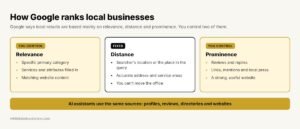
How Google ranks local businesses
| Factor | What it means | What you can do |
| Relevance | How well the profile matches the search | Right categories, services, description and website content |
| Distance | How far the business is from the searcher or the location in the query | Accurate address and service areas (you can’t move the office) |
| Prominence | How well known the business is | Reviews, links, mentions, local press and a strong website |
AI answers lean on the same signals. When an assistant recommends local businesses, it pulls from business profiles, reviews, directories and websites. Consistent, detailed information across all of them is what gets a business named.
The 8-step local SEO checklist
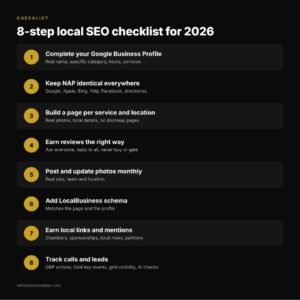
8-step local SEO checklist
1. Claim, verify and complete your Google Business Profile
The Google Business Profile is still the single most important local asset. Make sure:
- The business name matches the real-world name. Adding keywords or cities to the name breaks Google’s guidelines for representing your business and can lead to suspension.
- The primary category is as specific as possible. “Emergency veterinarian” beats “veterinarian” if that’s what the business is.
- Hours, services, products and attributes are complete. Every empty field is a missed chance to match a search.
- The profile links to the most relevant page, usually the location page, not always the home page.
2. Keep name, address and phone consistent everywhere
Your name, address and phone number (NAP) should be identical on your website, Google, Apple Maps, Bing Places, Yelp, Facebook and the main directories in your industry. Inconsistent data confuses both search engines and AI systems, which may then show the wrong phone number or old address.
3. Build a real page for each service and location
Don’t send every search to the home page. Create a page for each core service and, for multi-location businesses, a page for each location. Each one should include:
- The service area, address and an embedded map.
- Real photos of the team, the location and finished work.
- Local details: neighborhoods served, typical prices, local permits or regulations.
- Reviews from customers in that area.
Avoid “doorway” pages that swap the city name and repeat the same text. Google treats them as spam.
4. Earn reviews the right way
Reviews influence both rankings and conversions. Ask every happy customer, make it easy with a direct link or QR code, and reply to every review, positive and negative.
Do not buy reviews, write them yourself, or only ask customers you know are happy (known as review gating). Google’s review policies prohibit it, and the U.S. Federal Trade Commission’s 2024 rule on fake reviews and testimonials allows fines for fake or manipulated reviews.
5. Post and update photos regularly
Fresh photos and posts show customers, and Google, that the business is active. Upload real photos of jobs, staff and the location every month. Use posts for offers, events and seasonal services.
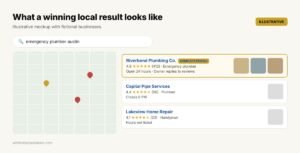
Illustrative example: a complete Google Business Profile in the local pack
Illustrative mockup with a fictional business. Notice what stands out: specific category, many reviews with replies, real photos and clear hours.
6. Add local schema to your website
Use LocalBusiness structured data (or a more specific type, like Dentist or Plumber) on location pages with your name, address, phone, hours and geo-coordinates. It must match what users see on the page and on your Google profile.
7. Earn local links and mentions
Prominence comes from the web talking about you. The best local links are often the easiest to earn:
- Local chambers of commerce and business associations.
- Sponsorships of local teams, events and charities.
- Local news coverage and community blogs.
- Supplier, manufacturer and partner directories.
8. Track calls, directions and leads, not just rankings
Rankings in local search change by the searcher’s location, so a single “rank” can be misleading. Track what matters:
- Calls, direction requests and website clicks from the Google Business Profile.
- Form fills and calls from location pages in GA4.
- Map pack visibility across a grid of points around each location.
- Whether the business is mentioned when you ask AI assistants for recommendations in your area.
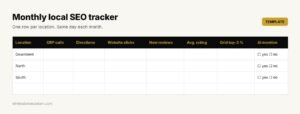
Monthly local SEO tracker template
Common local SEO mistakes
- Keyword-stuffed business names. They may work for a while, then lead to suspension.
- One page for every location. Each location needs its own page and its own proof.
- Ignoring negative reviews. A calm, helpful reply often wins more trust than a perfect rating.
- Old information in directories. Old phone numbers and addresses keep showing up in AI answers.
- Set-and-forget profiles. Profiles that go months without new photos, posts or replies tend to lose ground to active competitors.
When it makes sense to get help
Local SEO is simple but repetitive, and it multiplies with every location. For agencies managing dozens of local clients, the work adds up fast: profile updates, review replies, citations, location pages and monthly tracking. Many agencies hand that delivery to a partner that offers white label SEO services, so their team can focus on strategy and client relationships while the checklist gets done every month under their brand.
Whichever way you handle it, the rule is the same: give Google, AI assistants and customers complete, consistent and real information about the business.
FAQ
How long does local SEO take to work?
Profile fixes and category changes can show impact within weeks. Reviews, content and links usually take three to six months to move a business into the top three in competitive areas.
Can a business rank in a city where it has no address?
It’s difficult in the map pack, because distance is a ranking factor. A service-area business can still rank organically with a strong, genuinely useful page about that area.
Do Google Business Profile posts help rankings?
Google doesn’t list posts as a ranking factor, but they keep the profile active and can improve clicks and calls, which is what the business really needs.
Does local SEO help with AI answers?
Yes. AI assistants recommend local businesses using information from business profiles, reviews, directories and websites. Complete and consistent information makes a business easier to recommend.
About the author
Juan José Giraldo is a senior SEO, GEO and AEO specialist based in Medellín, Colombia. He works on technical and local SEO for 600+ U.S. car dealerships, supervises SEO for 18 U.S. e-commerce stores, and runs White Label SEO LATAM, a nearshore white label SEO partner for marketing agencies.